Quantitative research / Data engineering
NVIDIA Quantitative Signal Discovery Research Companion
An independent quantitative research framework for reproducible signal benchmarking, synthetic financial data analysis and chronological out-of-sample evaluation.
Offline CPU acceptance
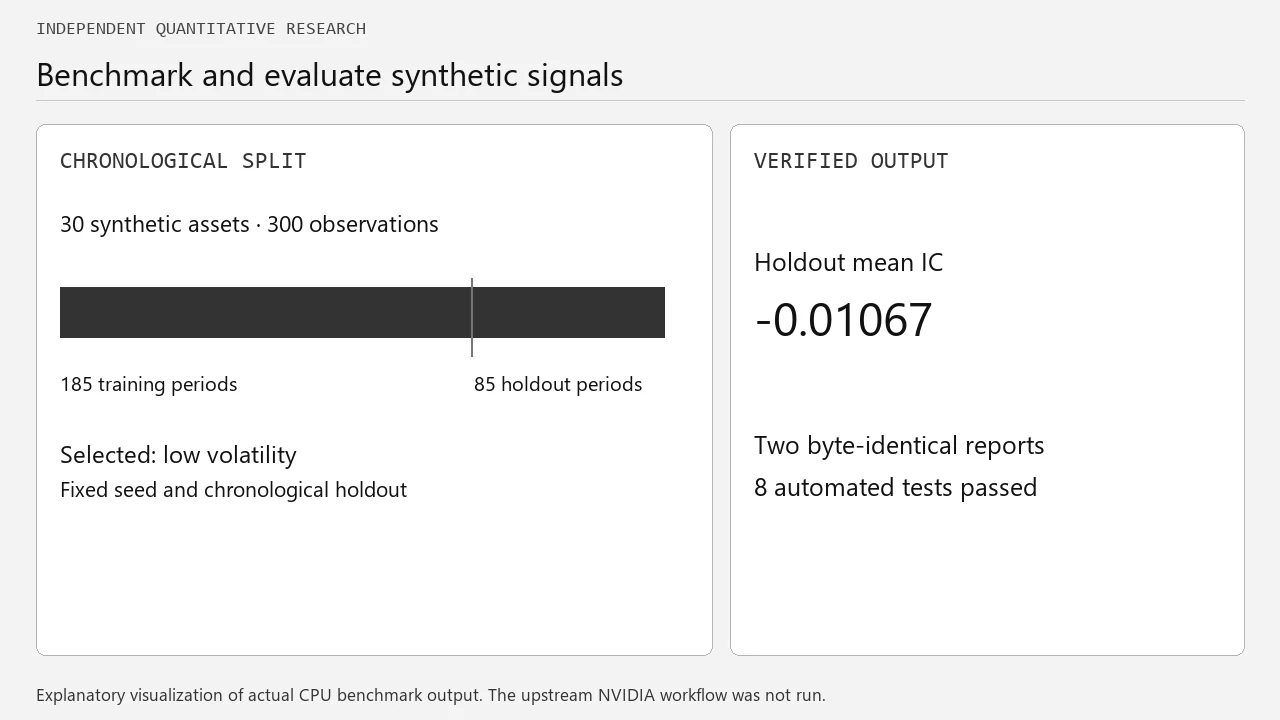
This independent framework generates synthetic returns from a fixed seed.
Candidates are selected during training and scored separately on chronological holdout periods.
Two CPU runs produced byte-identical reports and eight automated tests passed.
Problem statement
A signal experiment can look convincing if training labels overlap the holdout or if candidate selection sees holdout scores.
Engineering objectives
Build a reproducible CPU baseline that keeps candidate selection and chronological evaluation separate.
Architecture
A seeded price panel feeds trailing momentum, reversal and volatility features. Forward returns form labels. The harness ranks each feature against future returns per date and writes a JSON report.
- Seeded synthetic close panel
- Trailing features + forward labels
- Purged train / holdout split
- Rank-correlation report
Implementation
Candidate selection uses mean training cross-sectional Spearman IC. The final chronological slice evaluates the selected candidate separately.
Technical decisions
Purge the last forward-horizon positions before the split. Holdout features may use prices that were observable earlier. Dates with too few valid pairs or constant ranks are skipped.
Challenges and solutions
Feature and label alignment can silently drift. Axis checks and tests for constant ranks and trailing features guard against data leakage and invalid comparisons.
Automated testing
Eight tests passed across seed determinism, ranks, feature causality, input dimensions and holdout length.
Verified results
- Two CPU benchmark runs produced byte-identical reports.
- The selected candidate was scored on 85 separate synthetic holdout periods.
Limitations
The synthetic benchmark establishes no trading edge or profitability. NVIDIA’s upstream workflow remains unexecuted. This is an independent implementation with no NVIDIA affiliation or endorsement.
Future development
Keep any upstream evaluation separate, pinned to a reviewed revision and run only in an approved isolated environment.
Repository information
- Repository
nvidia-quantitative-agent- Validated commit
92d07fc- License
- Apache-2.0 (upstream attribution preserved)
- Source
- GitHub